Everything You Need to Know About Proteins
The number of dinners in America that include chicken is astonishing. From freezer meals to BBQ chicken to fried cutlets, from eatery chefs to college-dorm cooks, chicken is truly ane of America's favorite meats.
And yet chicken is besides often woefully overcooked. Fearful of contracting a nutrient-borne affliction from undercooked poultry, many Americans roast, fry, bake, or grill their chicken until it is dry, tough, and rubbery. Overcooked chicken doesn't "taste like chicken" anymore, it tastes more similar chalk.
Why is that? Read on to learn!
Cooked craven temps: safe concerns
All poultry, chicken included, accept Salmonella bacteria owned to their bodies—meaning that every single chicken has some Salmonella in it. The truth is that the chance that in that location is Salmonella in the particular portion of raw chicken you are preparing to cook is extremely high.
Of course, you lot needn't necessarily freak out nearly that, because Salmonella, just like other harmful bacteria, tin can hands be killed past cooking food to a loftier enough temperature.
The USDA publishes critical food safety temperatures for all foods, including chicken, that reverberate the heat needed to kill the bacteria usually associated with those foods. And almost people know that the recommended doneness temperature for food-safe chicken is 165°F (74°C).
The mistake most people make is not bothering to cheque the actual temperature of their craven! Instead, they rely on concrete indicators of doneness from a pre-technological era. Many people will bank check their chicken'southward doneness by checking to come across if information technology is firm when pressed, if it is no longer pink within, or if the juices run clear when the chicken is cutting.
Only those methods are seriously flawed! By the time chicken is "firm," the proteins in the meat will have squeezed out much of their h2o, making the craven dry. (As the proteins in the craven chest denature and curl upwardly, and, if they cook far enough, they squeeze out the water molecules that cling to them.) The color of meat is too a bad indicator of doneness because pinkness can be acquired past not-temperature related factors, such equally pH. Equally for cutting the meat to run into how the juices run, I suppose it could be a good doneness indicator if you want to eat craven that has had its juices literally drained out of it before it reaches your plate.
Below we'll cover three thermal paths to getting better chicken.
Beginner solution: check the chicken temp
The start—and most basic—solution to under- or over-cooked craven is to employ a thermometer when you cook your chicken! (A Thermapen® is ideal for this task, as you'll come across shortly.) Yes, your grandmother checked information technology with her pollex, only she learned to cook before computers were invented! Now nosotros have fast, accurate thermometers that tin can requite us far more information virtually our meat's doneness than a tactile push could.
To utilise a thermometer correctly in temping chicken, yous'll demand a thermometer that is fast enough to testify the differences in thermal gradients in the chicken.
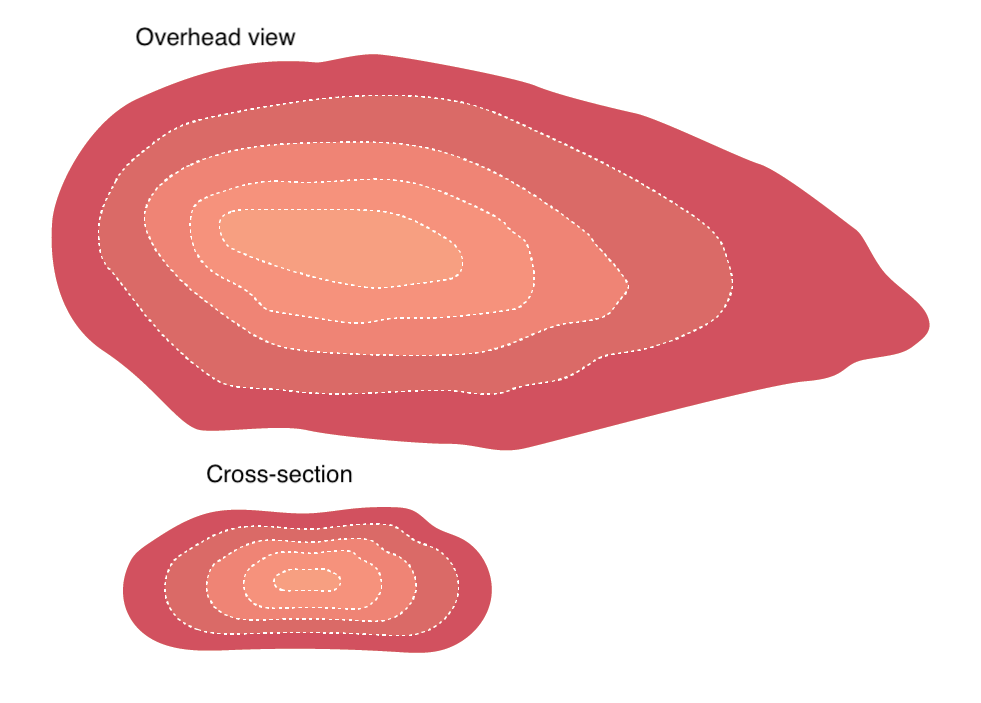
It goes without maxim that a chicken breast cooks from the outside in. As the outermost layer of molecules heats up, they share their heat with the next layer, and those with the next, and then on downwardly to the coldest spot in the chicken breast, the thermal center. Those differences in temperature make upward the thermal gradients.
To take the temperature of your chicken, push the tip of your thermometer's probe through the thickest part of the meat and pull it slowly up through the meat. Watch the display for the lowest number that it reads: that is the doneness of your craven. That'due south why y'all need a fast thermometer, to read the gradients as you motion the probe through the meat.
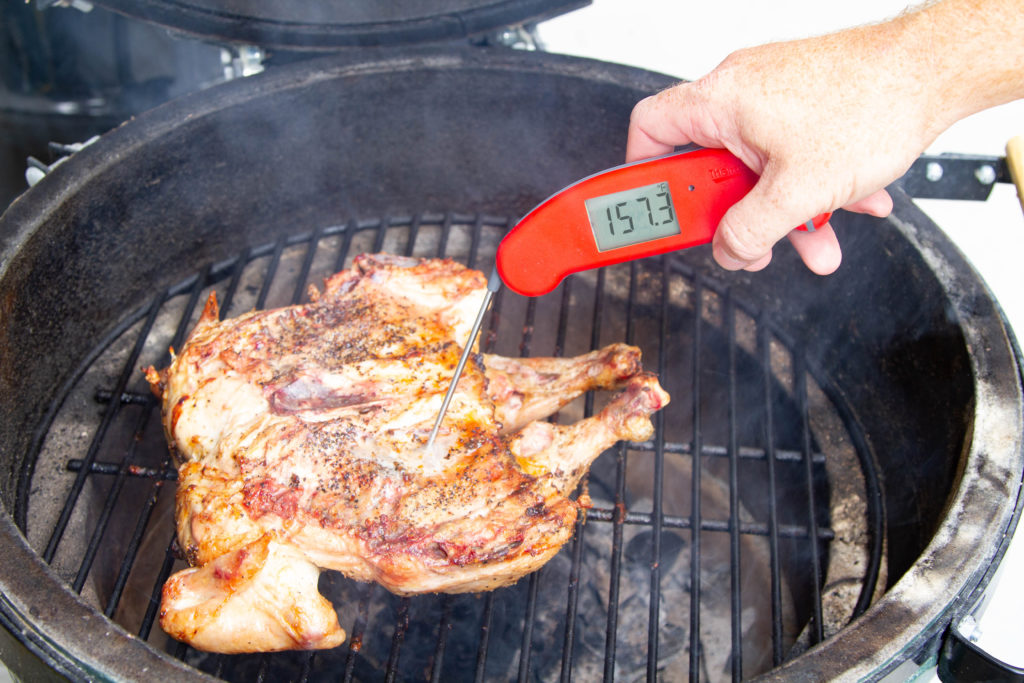
By checking actually using a thermometer you can nail your target temperature without going over. Better chicken is within accomplish…
Is 165°F really key? Bacterial decease is dependent on temperature and time
Ok, so most people know about 165°F (74°C), but what most people don't know is that food prophylactic (bacterial die-off) is a role of both temperature and time. Y'all can achieve the exact same bacterial death by holding your craven at lower temperatures for longer times with the verbal same assurance of condom.
The USDA provides guidelines for industry on nutrient condom and uses pasteurization tables to signal how long it takes to kill enough bacteria at a given temperature. Below you tin can encounter i such tabular array for medium-lean chicken.
Chicken Condom Temperature Chart
| Temperature | Time to attain bacterial death (in lean white meat) |
|---|---|
| 145°F (62.8°C) | 9.8 minutes |
| 146°F (63.3°C) | 7.9 minutes |
| 147°F (63.9°C) | 6.iii minutes |
| 148°F (64.4°C) | 5 minutes |
| 149°F (65°C) | 3.9 minutes |
| 150°F (65.6°C) | 3 minutes |
| 151°F (66.one°C) | 2.2 minutes |
| 152°F (66.7°C) | ane.7 minutes |
| 153°F (67.2°C) | 1.iii minutes |
| 154°F (67.8°C) | 1 minute |
| 155°F (68.three°C) | 49.v seconds |
| 156°F (68.ix°C) | 39.2 seconds |
| 157°F (69.4°C) | 31 seconds |
| 158°F (70°C) | 24.v seconds |
| 159°F (70.6°C) | 19.4 seconds |
| 160°F (71.ane°C) | 15.3 seconds |
| 161°F (71.seven°C) | 12.1 seconds |
| 162°F (72.2°C) | nine.six seconds |
(This chart is based on guidelines from the USDA for food manufacturers. Yous can read the whole article and get expanded charts in PDF version of the document beneath.)
Intermediate solution to dry chicken: cook to 157°F and Concur it
If yous want even meliorate chicken than you go from temping your chicken to 165°F (74°C), use the pasteurization tables to selection a lower temperature to cook to, and hold your chicken at that temperature for the appropriate amount of time.
(Annotation: the pasteurization tables vary depending on the fat content of the meat, though they don't differ much across the fatty percentages. Breast meat is very lean, while thigh meat is much fattier. Apply the tables appropriately.)
With this method, you would pick a temperature from the chart, verify that the chicken has reached that temperature as you nosotros discussed above, and hold it at that temperature for the appropriate fourth dimension interval. I really like 157°F (69.4°C) for my chicken, so I'd hold it at that temperature for 31 seconds.
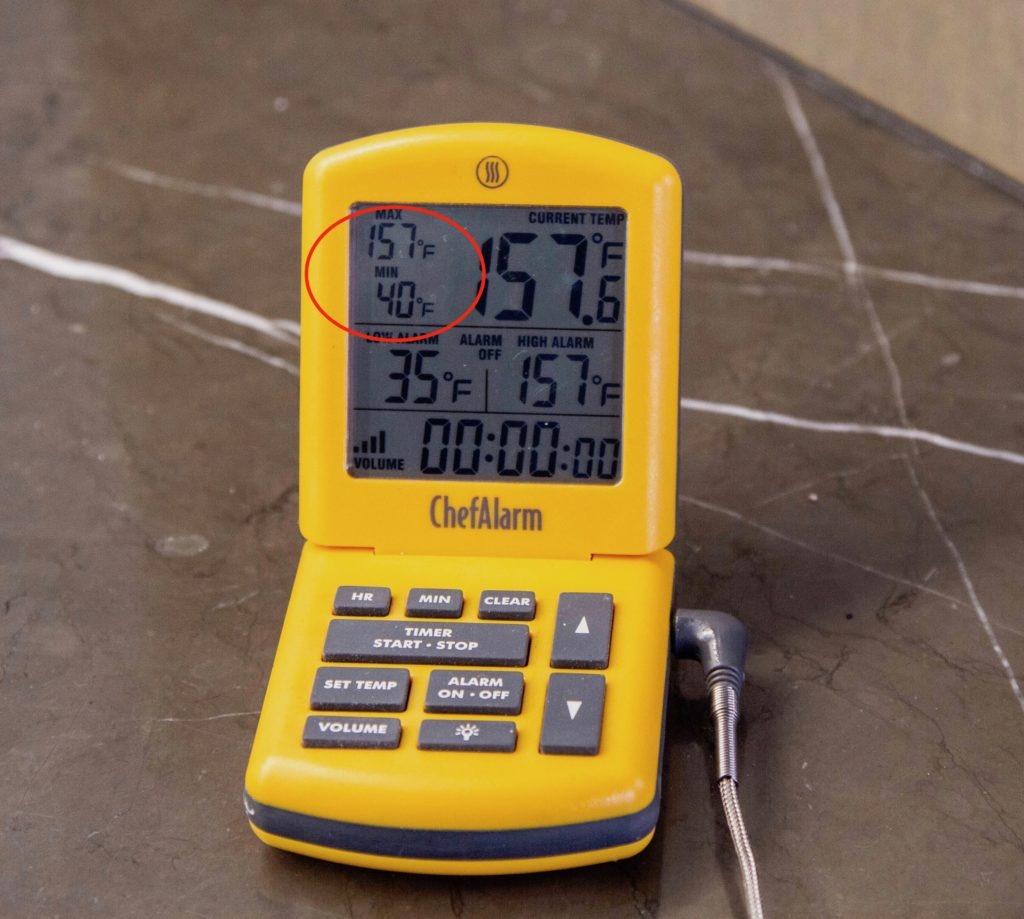
Y'all can use the min/max function on your ChefAlarm® to monitor the temperature and make sure it doesn't dip during your holding fourth dimension. In the above image, the min temp is 40°F. By pressing and belongings the Articulate push for a few seconds, the min/max volition be reset to the current temperature. You lot can hist outset on the timer and watch it for 31 seconds. You can then bank check the min temp to see if it dipped beneath 157°F (69.four°C).

Advanced thermal thinking: carryover cooking in chicken
If you're concerned nearly holding it at 157°F (69.iv°C) for 31 seconds, yous certainly needn't exist: carryover cooking will brand certain your meat is rubber!
Most people don't realize that when yous have a craven chest off of the heat, the residual heat in the outermost layers of the chicken will cause the internal temperature to keep ascent, creating a temperature equilibrium in the whole piece.
This is advanced thermal thinking because it requires more judgment—it entails a dynamic target with 2 variables: the temperature of the cooking environment and the mass of the meat being cooked.
Meat cooked in a hotter environment volition have more carryover because in that location will be more than thermal free energy in the outer layers that will be pumped into the middle. Hotter cooking means more carryover cooking: chicken cooked in a smoker at 250°F (121°C) will have much less carryover than a spatchcocked chicken roasted at 425°F (218°C).
A large piece of chicken, say a whole bird, will have a lot more than thermal mass that tin motion heat into the eye, meaning the internal temperature will rising more than on a pocket-size slice of chicken. A chest experiences less carryover than a whole bird does, and a fly even less.
What that means for you is that you might set an even lower doneness temperature on your ChefAlarm when you roast a whole chicken than yous would if you were just blistering some breasts. Equally y'all get used to monitoring temperatures, y'all will gain a sense for how carryover works in various situations and be able to set your alarms meliorate to get exactly the results y'all want.
Dark-meat chicken temps: 175°F (79.4°C)
Everything we've discussed upwards to this point is focused on cooking chicken breasts. Dark meat is a whole other kettle of fish. While dark meat does demand to exist cooked to a safe temperature, it must really exist cooked to a college temperature to exist enjoyable. Dark meat has much more connective tissue in it, and that tissue needs to be broken down to make it tender. If yous don't like dark meat because of its gummy, rubbery texture, then you aren't cooking your night meat hot enough! For the connective tissues to break downward, nighttime meat must be cooked to at least 170°F (76.seven°C), but it is even better if cooked to 175°F (79.4°C).
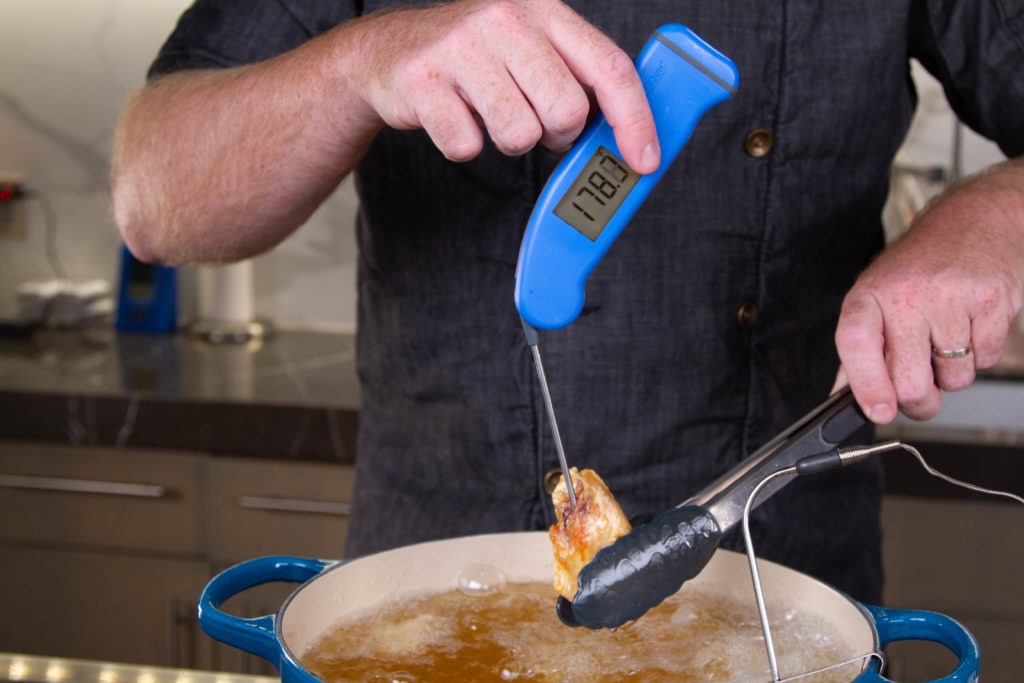
Merely won't that dry out the meat out, like in the breast? No. Equally the connective tissues suspension down, they actually release h2o into the meat, replacing the wet lost in the initial protein-squeeze. In fact, chicken thighs can reach a consistency much similar pulled pork if cooked just correct!
Recap: temp your chicken!
Nearly people overcook chicken because they use physical artifacts to cook information technology, instead of really measuring its temperature. The only mode to know how well your craven is cooked is to use a thermometer, preferably one that is fast (then you lot know what's happening now) and accurate (and then you know you're not beingness lied to past your thermometer).
Though the USDA names 165°F (74°C) as the doneness temperature for craven, cooking it to a lower temperature and property information technology at that temperature for an appropriate fourth dimension will result in juicier, tastier chicken. Add to ensure safety when cooking to those lower temperatures, track your chicken'southward carryover cooking.
By following these guidelines and using a Thermapen® and a go out-in probe thermometer to melt chicken, you lot'll get meat that is safe, juicy, and tastes improve than, well, chicken! Happy cooking!
And at present that you know how craven temperatures work, take a look at some of our other posts on craven:
- Sheet pan chicken
- Baked craven breast
- Delicious fried chicken
- BBQ chicken thighs
- Butterflied whole grilled chicken
- Simple roasted chicken
And if you want to know more about the difference between the ChefAlarm and the Thermapen, you tin can read upward on which thermometer to use.
Shop now for products used in this post:

richardsonelies1942.blogspot.com
Source: https://blog.thermoworks.com/chicken/chicken-internal-temps-everything-you-need-to-know/
0 Response to "Everything You Need to Know About Proteins"
Post a Comment